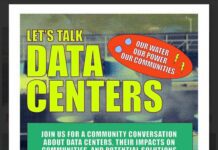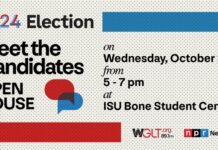
On Monday, April 20th, 2026, Citizens Utility Board, Faith in Place, Illinois Environmental Council, and Prairie Rivers Network held a town hall at the Bloomington Library about the increasing prevalence of large-scale data centers.
From the event page description:
Data centers are expanding rapidly across Illinois, bringing new demands for electricity, water, and infrastructure. But communities are often left without clear information about how these facilities may affect local resources, energy prices, and environmental health.
What do these developments mean for our water supply? How might these affect our energy grid and utility bills? How can communities ensure their voices are a part of the discussion that affect our shared resources?
The following is a transcript of the event:
Andrew Rain
Okay. Um, great. So let’s get started. So, who are we? We just listed the groups that were immediately involved in planning this, but we’re all part of the Illinois Clean Jobs Coalition. So, that’s a group of nonprofits that work on a variety of environmental issues aligned around climate advocacy, that have worked on policy in the state for many years. We did a similar kind of community conversation model a number of years ago when we were working on the. Climate and Equitable Jobs Act, and so why are we doing this? It’s because. It’s both about listening and education. So we’re trying to inform policy creation around data centers while it’s moving forward. We need to get that feedback and hear from you all, but we also want to just sort of work on advocacy, make sure everybody knows what’s going on, And sort of hopefully help you understand what you can do regarding data centers in your communities.
Um, it’s a mix of presentations and breakout groups, as Sonny noted. Uh, and briefly we’ll do an introduction, kind of give you a lay of the land with data centers. Um, and then we’ll have a little welcome breakout. And then we’ll do impacts of data centers and we’ll have an impact breakout. And then solutions for data centers and then the solutions breakout. Um. So when you get to the impact one and you’re thinking, why aren’t we talking about solutions yet? It’s, just because we’re just not talking about them yet. That’s the next thing in the agenda. And, then we’ll give you some next steps so you can leave with some actions. And so with that, I’m going to dive right in. So what is a data center? So the data center is a warehouse full of computing power. The point of a data center is to generate compute, the resource that is running the internet and storing data, and it’s also creating AI models. We’ve had data centers for decades. In some ways, these aren’t new. But in some ways, they’re really, really, really new.
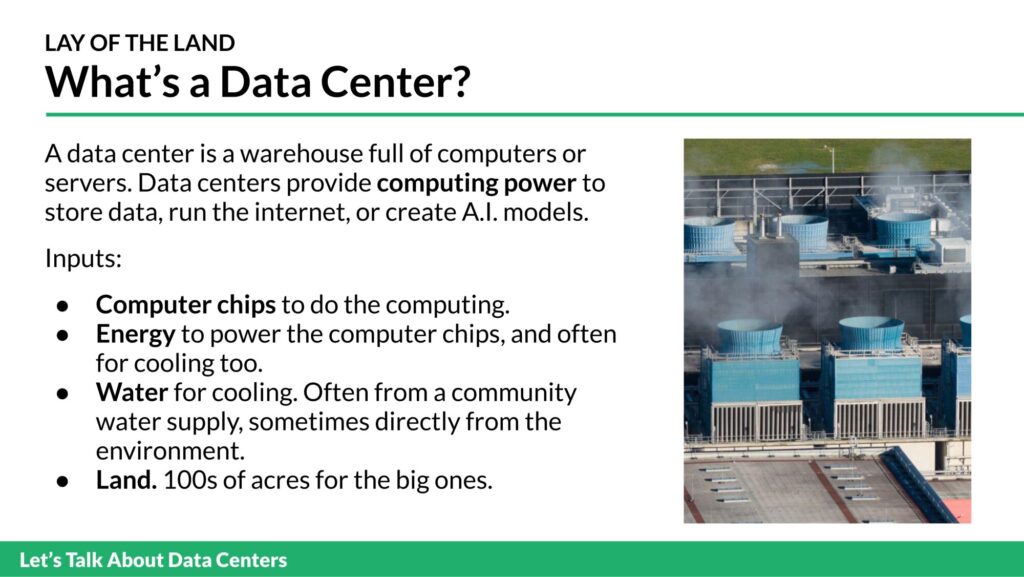
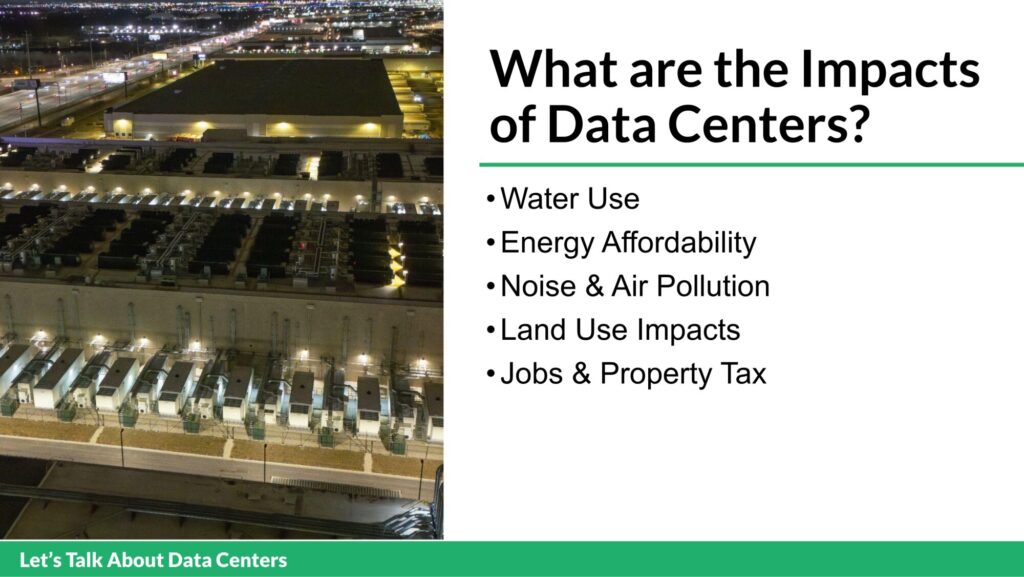
We’re seeing a big change, and I’ll talk about that in a second. But just to say what what goes into these data centers, well, you’ve got computer chips. That is the big thing making all that compute happen. You have energy to power those computer chips and also to run cooling. You have water often for cooling, sometimes in massive amounts. And then you also have land. The new data centers can be hundreds of acres. The one in Joliet that was just approved is going to be the size of Central Park in New York. So they can get really, really, really big.
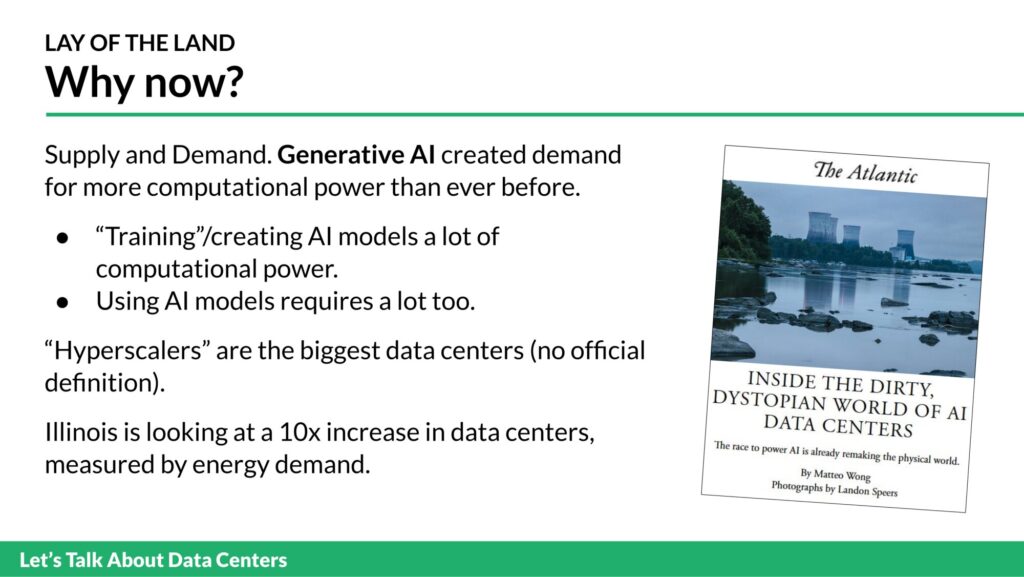
Why is this happening now? Generative AI has created a moment in which there is so much demand for that computing that we’re seeing data centers at scales we’ve never seen before. The largest operating data center in Illinois right now is I’m going to give you an energy number, one hundred and fifty eight megawatt. The one in Joliet is one thousand eight hundred megawatt. That’s more than ten times the energy consumption, land use. Things like that impact scales with that energy consumption. So we’re seeing a big jump into what’s called a hyperscale data center. Some people will say, a hyperscale starts at fifty megawatt, and it goes up to whatever is bigger than fifty megawatt. And suddenly, we need we need to differentiate our hyperscalers because they’re just getting so big. And we’re looking at a tenfold increase in Illinois.
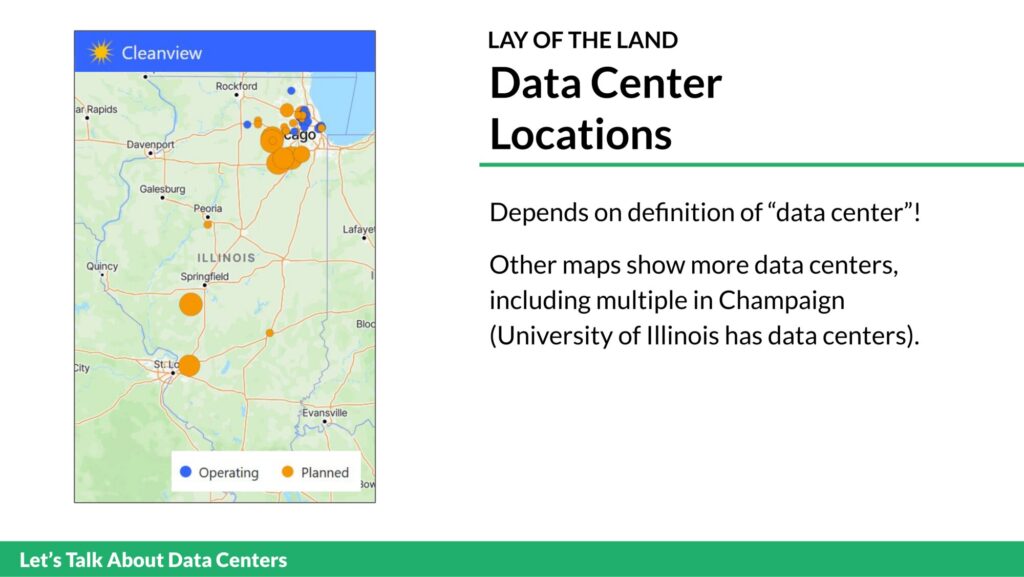
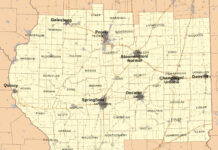
All over the state, more and more we’re seeing some of the bigger proposals down here. This map is probably outdated already because it’s moving so quickly, But this map shows kind of the location of where some of the data centers are. I will say this probably doesn’t capture the small data centers that exist everywhere. There’s one in a closet somewhere in this building right now. But also, you know, University of Illinois has a supercomputer.
These things are not anything compared to the big ones that are associated with the AI boom. Um, and I want to touch on that scale. I kind of spoiled myself on this, but um here’s some some articles.
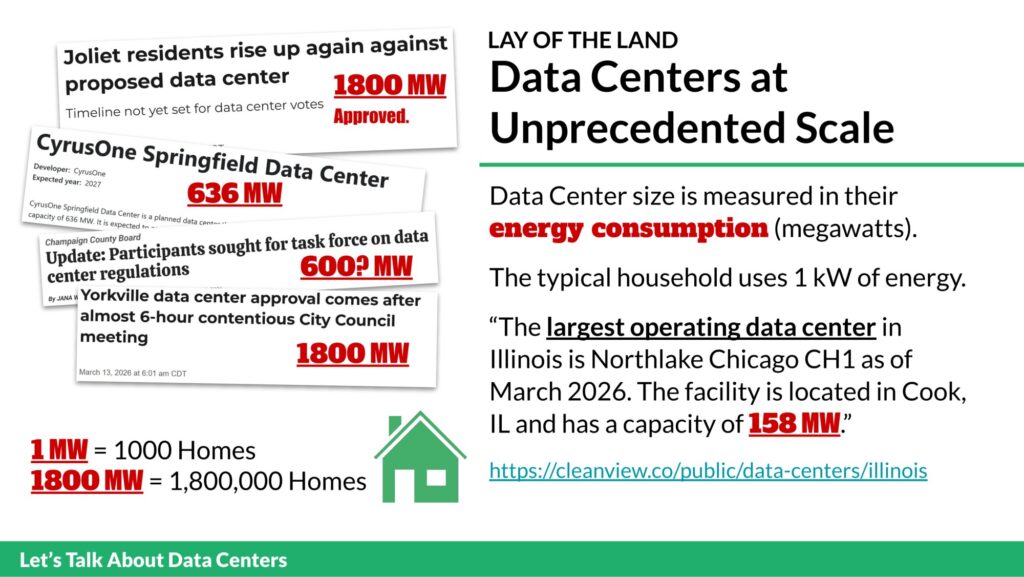
Uh, there was a one thousand. Well, let me start with what let me talk about energy first. So a household uses a kilowatt of energy. So, imagine you plug in your household, it would be drawing a kilowatt from the grid, and you don’t need to know more about the grid than just say. That’s a kilowatt. Like understand that scale of a household. So, a megawatt is a thousand homes. So Joliet, where they approved a one thousand eight hundred megawatt data center, that’s like. A data center that’s going to use one million eight hundred thousand homes worth of energy demand. That’s how much energy demand these data centers are. That’s the best metric; energy is right now the best metric for data centers, but. The land use scales, the water use scales, everything scales with the amount of of energy they’re drawing. Cyrus one in Springfield, Um which is a ginormous six hundred and thirty six megawatt that happens to just seem tiny next to the insane data center in Joliet. We’ve got rumors in Champaign of another six hundred megawatt one. There’s another one close to the Joliet one that’s thousand eight hundred. And that’s again compared to the biggest one we have so far is a hundred and fifty eight megawatts.
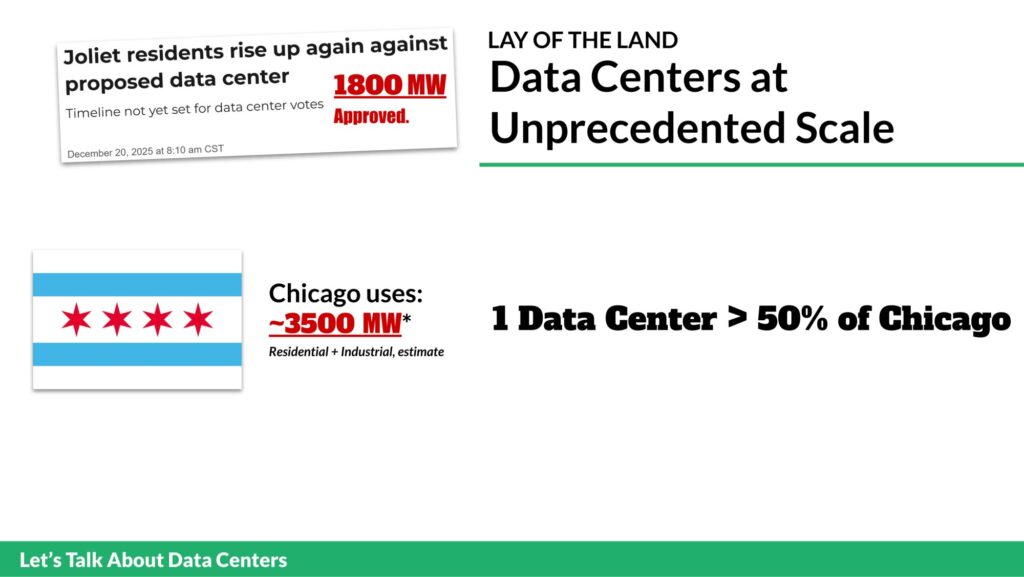
Chicago, Chicago’s plug-in value, If you were to plug in the city of Chicago is three thousand five hundred megawatts. So one data center is more than half of Chicago. And that’s new demand. That’s new energy that needs to be generated to meet the demand of data centers. And that’s one, granted large, but one data center being proposed. One estimate had eight thousand five hundred megawatts of data center capacity coming down the pike at us planned. Um. That number. Depends on who you ask.
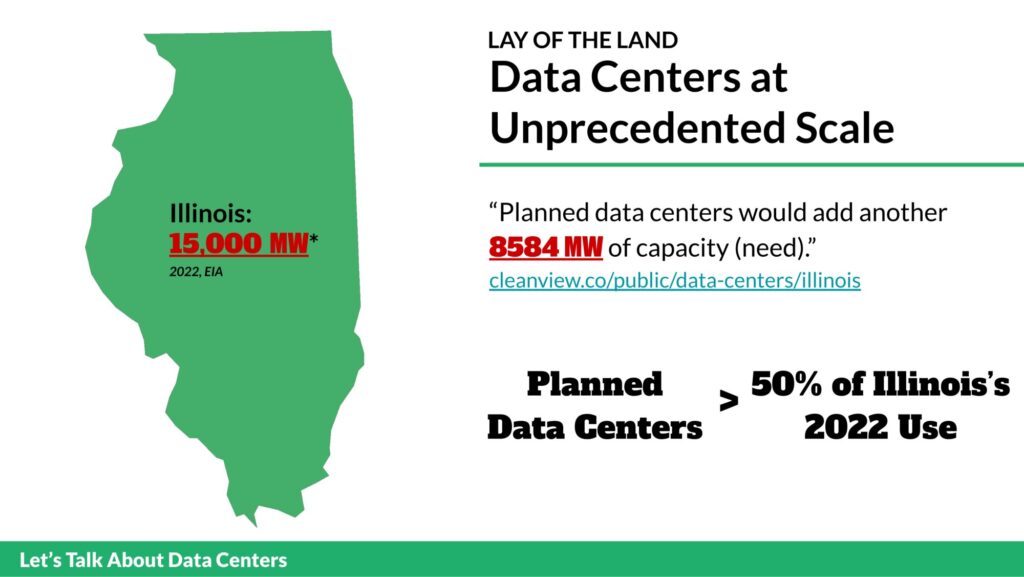
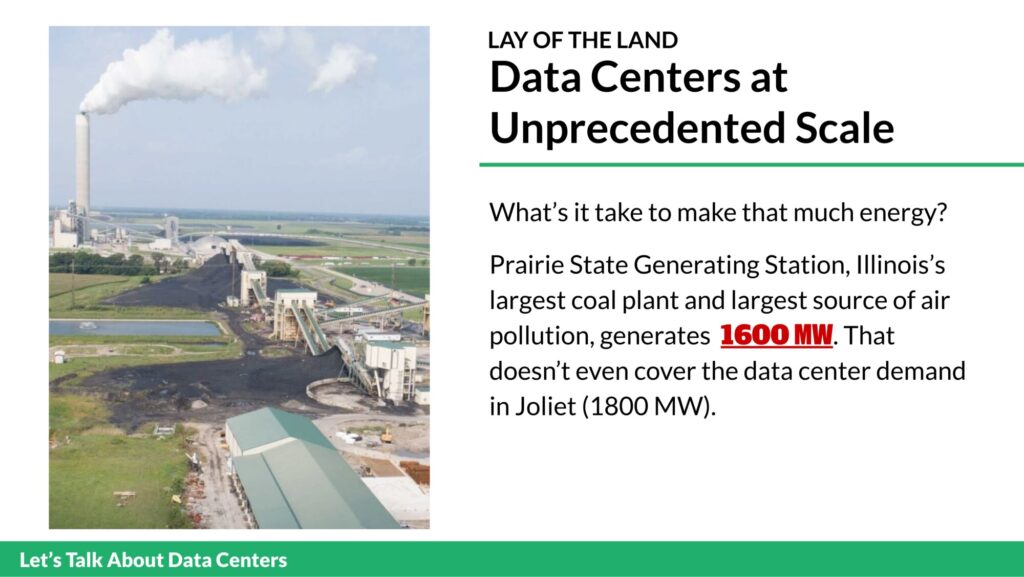
The grid operator in northern Illinois, PJM, said something like twenty-two gigawatts. So that would be Two thousand two hundred megawatts. Thank you, math on the spot. Um, okay, Illinois plug-in value is fifteen thousand. Right, So again, we’re plugging in the state of Illinois; it’s going to consume in 2022: fifteen thousand megawatts. That’s it, and these data centers are going to be more than half of that. By themselves. So this is what’s coming. And lastly, what’s the other side of that? Remember, data centers are consuming energy; they’re not making energy. So, the other side of that is that generation. And okay, so how should we think about the Joliet data center? Well, the largest coal plant in Illinois, the seventh largest single source of CO two in the country, is the Prairie State Generating Station. That generates one thousand six hundred megawatts, which you might know is not enough to power the Joliet data center, shy by two hundred megawatts. So, the amount of generation we need to meet this demand is also just astronomical. And so I am going to give it Scott to talk a little bit about some local news.
Scott Allen
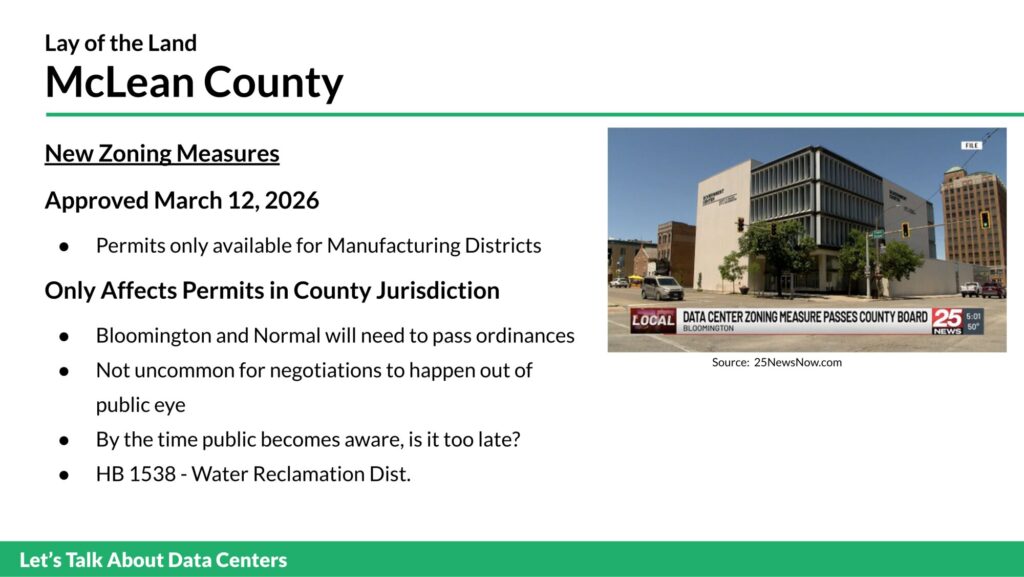
And I’m glad we had some journalists here and a county board member as well. To correct me if I get anything wrong, But all across the state, we’re seeing counties doing different things with data center, zoning regulations and municipalities as well. So in McLean County, earlier last month, our county board. Past what was I think generally considered a pretty good protective. Zoning measure saying that if a data center wants to come and get permitted from McLean County, it has to be in the manufacturing district. Now that is just for the county, though. So if we have data centers that approach Bloomington, Normal, or any other towns in the county. That will rely on whatever ordinances they have on the books. So what we’re seeing other municipalities do is start to prepare those ordinances. The city of Aurora is a really good example of that. It’s not uncommon for a lot of the details to be worked out outside of the public eye. We’re finding around the state. So you’ll find that counties or in some cases, municipalities have been in discussions for two or more years with the data center, get all of this stuff worked out, and make sure that they check all of the boxes. So when they go through the permitting process, they can kind of sail through that. Um. And we have, I think all of us have talked to people in various parts of the state who said, “By the time I first heard about this, saw it on the agenda. It was way too late to do anything.” So, just a heads up. And we had a message Representative Chung was hoping to be here this evening. She wasn’t able to make it, but she worked on passing a law last year’s HB 1538. That would, she hopes, if we’re put in a position where data centers come, they require a lot of water, that the reclamation district can sell to them. But, but, water untreated water. So she wanted to make sure that we mentioned that.
Andrew Rain
All right, I’m gonna bring us back. Thank you all for enjoying that first discussion. We’re gonna be having a little bit of deeper conversation at the next breakout. Um, talking about sort of the impacts of data centers. And so I do want to be humble here. I think it’s a there’s a lot going on with data centers. We’re going to talk about the impacts that that we see, Some of the things we’re trying to address with the bill uh that I’ll talk about later, The Power Act um But. Part of the goal today is to hear from you about your concerns. When you think about a data center coming to town, what does it mean to you? What are you worried about? Are we missing something? That’s, to me, One of the critical things : is if we’re not talking about something that you think is really important, I want to know what that is.
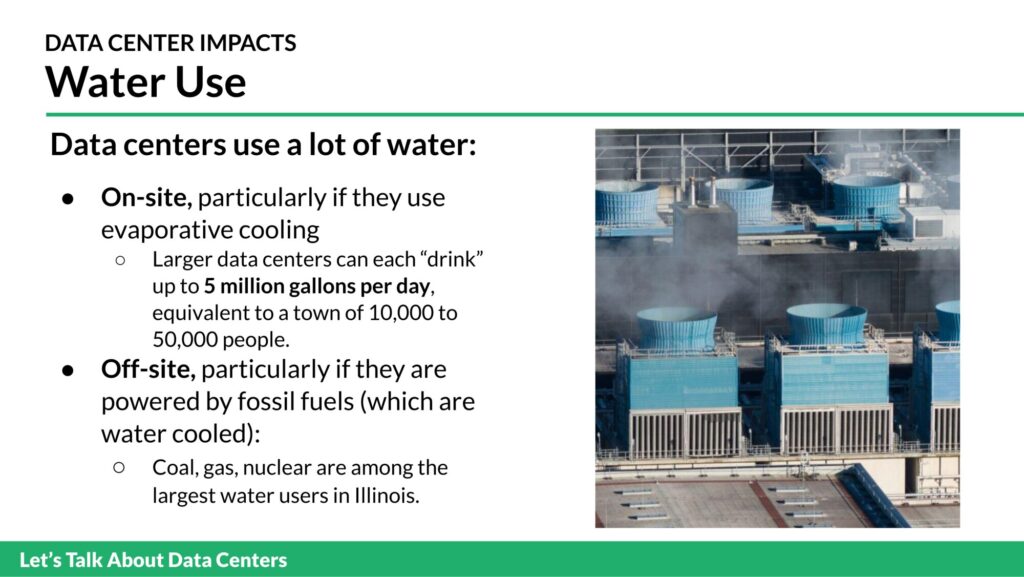
So, with that, I’m going to get into a discussion of some of the data center impacts. All right, so, um, Prairie Rivers Network. We think a lot about water. And so I think water use is a big impact of data centers that we need to think about. Um And the truth is that data centers can use a lot of water. It does depend, But there are data centers that are large data centers using evaporative cooling can be using something like five million gallons per day. This is one data center behaving like an entire town of water use. I will note here that like Data centers aren’t particularly transparent about this, and so the numbers are harder to come up with. They don’t Aren’t reporting their water use in most instances, so we don’t have a way to to really.
I wanted to go through like I did with the megawatts and be like, boom, this how much this one’s using. Boom, this how much this one’s using. And the data just isn’t out there. And so transparency itself is one of the big issues on water use. But, we do know that they can be big water users on site for cooling. That’s because they need to cool all those chips down. The biggest thing that a data center produces, besides computing power and headaches, is Heat and that heat’s got to go somewhere. And that somewhere is often into water, and that’s why they’re using water. But there is also water use off site. So the biggest water user in the state right now is thermoelectric power generation, or among the biggest, kind of depends on how you count. That means fossil fuel power plants, gas power plants, coal power plants, nuclear power plants. They use a lot of water also for cooling. So, we make heat when we make the megawatt and then we make heat when we consume the megawatt.
And both of those heat have to be cooled, and we’re almost always using water to cool those. So, there’s this compounding effect that a new gigawatt – sized data center that requires a gigawatt power plant is going to be using water at the data center and at the power plant. Um, and the cooling demands of the power plant are even higher. So there’s a lot of offsite water use also associated with data centers. So there’s real reason to be concerned, and there’s a real lack of transparency on this issue across the board.
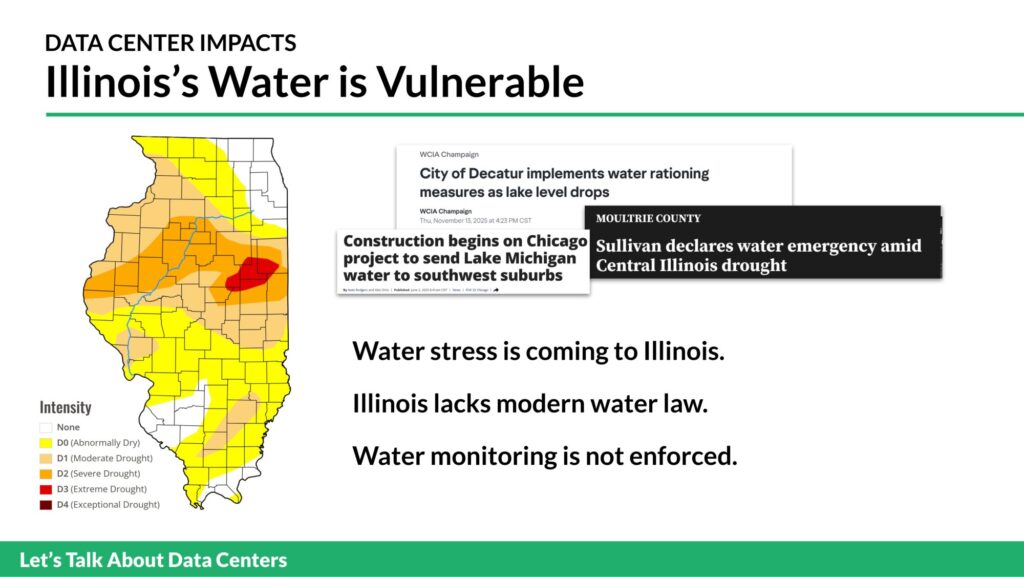
And the other thing is that Illinois is vulnerable. So, we this actually this map is now old. We have wintered our way out of a record drought. March was super wet, and so we the map actually looks a lot better, but Many people here, you know, I think Bloomington was calling for voluntary water conservation efforts as the lake was getting lower. One of the, I think the city director or someone in Sullivan testified to a Senate committee that their groundwater wells were fifteen feet lower than they typically are. Um, And Joliet is now, uh their aquifer is no longer able to provide them water. And so they’re going to Lake Michigan for their water. So, we’re starting to see water stress come in a state that has previously not really thought about water stress. I’m not saying the apocalypse is here, it’s just clearly something we need to start thinking about. And we don’t have laws that help us think about this. This is what makes Illinois pretty unique in this case. Other laws, even our neighbors, have water use law, water use reporting. We have very, very simple water use law imported from like the U K. And it’s simply like if you make my well go dry I can sue you. But, we don’t have a water use framework that thinks about a resource and says, can this resource handle another large water user? And without that sort of framework.
We’re pretty vulnerable to large water users showing up and starting to use large amounts of our water. Um, we do have water monitoring that is required, but it’s not enforced. And anything that’s required and not enforced is actually not required. So we don’t have water monitoring properly either. So we’re pretty vulnerable on the water side, and data centers can use a lot of water. So There’s more to say on water, of course, but I do want to make sure we go to our other topics. So I believe that brings us to energy. Yeah.
Scott Allen
So uh. Just like the Prairie Rivers Network, they have a lot of concerns around water. Citizens Utility Board, we have a lot of concerns around energy affordability. So, just as I will try to keep this as understandable as possible, how many people are Ameren customers? Okay, versus corn belt. Okay, We’ll talk more about the corn belt side of things a little later in the presentation. This going to make the most sense from a regulated utility perspective. And, we’re also going to talk about some of the claims that we’ve been hearing from data center representatives, and I’m sure that you all heard it too somewhere, That this not going to cost anybody anything because we’re going to pay for all of that. Well, we have a concern. Two categories of cost drivers when it comes to us utility ratepayers.
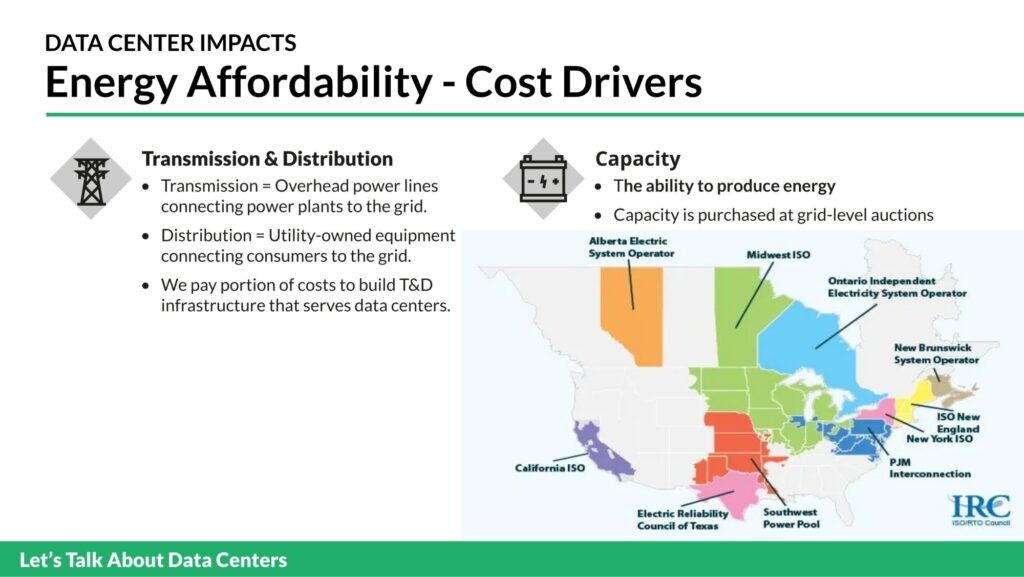
The first is on this infrastructure side, the transmission and distribution. So Andrew’s described these gigantic facilities, right? They use as much electricity as a mid-sized city or a large city even. So, you can imagine the amount of infrastructure that it’s going to take for the utility to serve that customer as a data center. That’s poles and wires and transmission lines. Substations and all of that stuff. Um. For us, Cameron customers, the regulated utility customers, we all pay for that infrastructure. So when a data center says, “We’re going to pay the cost of that upfront. Don’t worry about it. “ We don’t have those rules set up for cost allocation in the state for that to happen, for them to write a check to the utility. They make a deposit. The utility starts to buy infrastructure and build it. It’s very, very expensive. Utilities love building infrastructure because that’s how they make money.
They recover their cost for that infrastructure, plus nine or ten percent profit for their shareholders on top of that. So they love building infrastructure. But, we simply do not have the rules in place for the data center to just write a check to the utility for that infrastructure. It is recovered from all of us on our bills. So that’s one side of it. The other side of it is the energy generation side. Andrew kind of gave you an idea, I think kind of the unprecedented massive amount of load that we could potentially have from data centers. If any of you again, Ameren customers, uh opened your bill, your Ameren bill last July maybe or last August. Whether or not you noticed, it did go up quite a bit from the month prior. That was a function of data centers.
It was more specifically a function of what we refer to as capacities, capacity markets and auctions. So, a power plant, sells two things: they sell energy and they sell capacity. Capacity is their ability to show up when needed. So we look at this map here, and we live in one big grid minus Texas. Texas isn’t connected to the rest of us. But, our grid is this one big connected machine, and then it’s split up into regional zones. So you see Illinois here is part of two regional grids: MISO for us down here; PJM for people in northern Illinois. MISO’s job as an entity is to make sure that the grid is reliable, that they have enough power being generated, and it’s delivered to the people who are using it. And, to secure that, to make sure that you have that availability, that generation when you need it, they hold these capacity auctions. And that is what caused our prices to spike last summer. So again, a capacity auction is to ensure that we have all of these power plants who are out in MISO’s territory. If they are willing to bid into this capacity auction and say, “if you give me that four hours’ notice, I can turn on.” Otherwise, they’re going to be generating their base load electricity. It’s going to go out and they’re selling that energy. But the grid operator wants to ensure that when we need you, you will show up. And so they bid into this. They say, “Yes, I can show up in 2025.” Last summer, we saw these capacity prices jump from around twenty six dollars per megawatt day to almost six hundred and seventy dollars per megawatt day. So one day it was twenty something, the next day it’s six hundred and sixty something. In one day, is it over two thousand percent increase? And again, the same thing happened in the PJM grid in northern Illinois. Um, the market monitor, the firm that is responsible for watching over these capacity auctions and analyzing and reporting about them. They blame this on data center speculation. So, what’s happening here is that you have a data center who’s going out and maybe they’re talking to eight utilities in MISO’s footprint in this green territory. Well, MISO’s job is not to guess where they are going to build one or two data centers. They have to assume that they’re going to build all of them. They don’t have the luxury of being wrong. They have to make sure that we have enough power out there when we need it. And so they put together this portfolio. They say,
This how much load we have currently on our grid. This how much we could potentially have. This how much generation we have on our grid, And this what we expect the weather to look like over the next year. So they turn this information over to those power plants, and they say, these are the needs that we expect to have to meet. Can you meet them? Well, a power plant is looking at that and saying that well, Normally, this gas plant that I only run maybe twice a year to meet that peak demand. I would have to run that probably eight times a year, or nine times a year for longer durations. That’s fuel, that’s money, that’s operations and maintenance costs, that’s labor costs. So, the plant owners are saying, “We can meet that demand. We might have to build another plant. We might have to build some more infrastructure. We can meet that demand, but it’s going to cost you.” And so that is what caused our prices to go up last summer. We don’t know yet what our prices will be for the coming year, but we know for our friends up in northern Illinois.
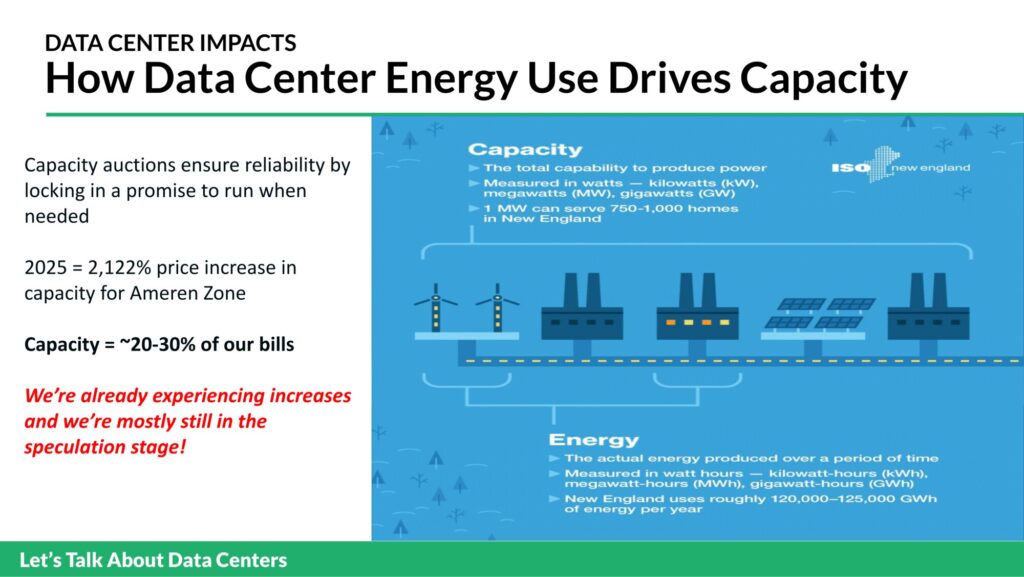
They have it worse this summer than they had it last summer, and we expect that trend to continue until we do something about this. And I’ll get into that in just a second, but just keep in mind that this all in the speculative stage. This driving the markets crazy just on the threat that this might happen. When these things, if these things actually start, if you have a two gigawatt data center come online, we’re going to see these problems get really, really, really quickly. And, then we have an issue of do we physically have enough supply to meet this demand. On the other side of that, though, a data center, especially the ones that are doing AI training, they like to run around the clock, twenty four hours a day. So they’re not going to count on the grid staying up all the time. They’re not going to count on you know a storm coming through. They’re going to bring their own backup generation. Typically this is diesel backup, gigantic diesel generators.
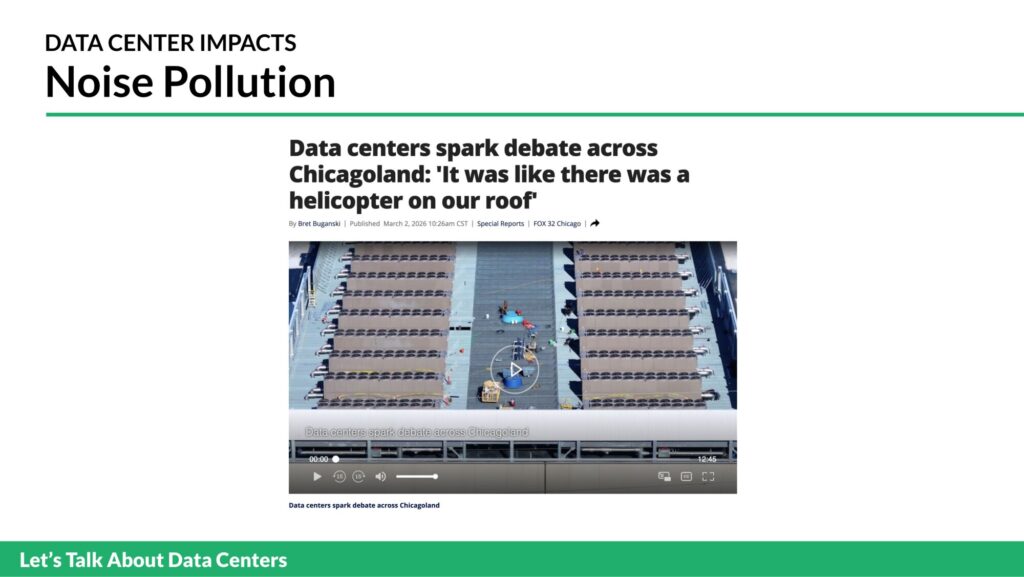
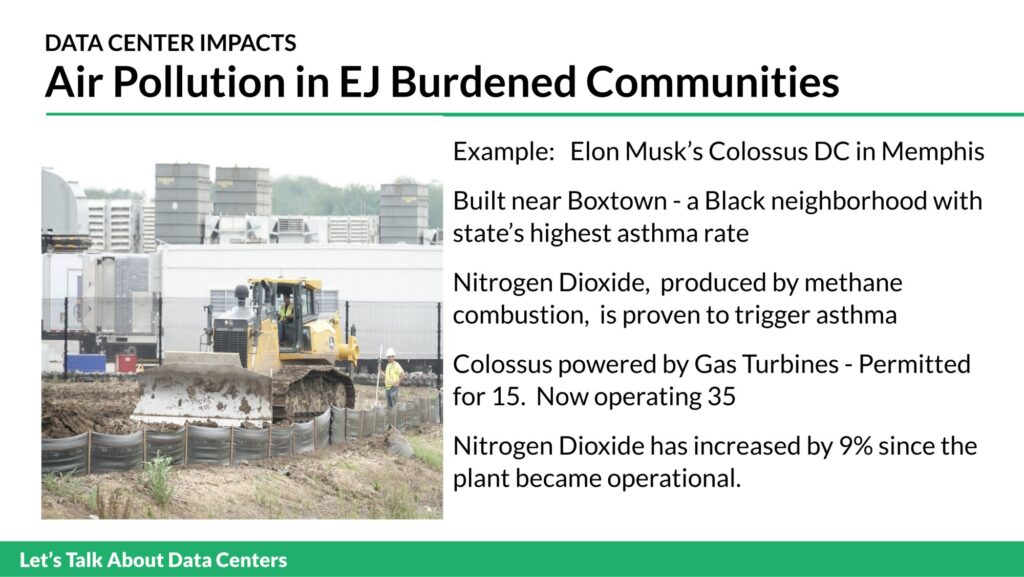
And it’s hard to say for sure, but we think it’s pretty safe to assume that if you are a, say you are a one hundred megawatt data center, you are probably going to bring about two hundred megawatts of backup diesel generation. If it’s hard to imagine what that must be like to be in or around a data center that is using, never mind the noise — which apparently drives people a little bit insane — it’s choking people too. It’s choking you with the emissions. If, you ever have a chance to talk to somebody in Aurora, who has suffered next to one of these data centers for the last several months, do that if you want to see some righteous anger about all of this.
Andrew Rain
Alright, let’s go to the next slide. So another thing is data centers use a lot of land in a rural area.
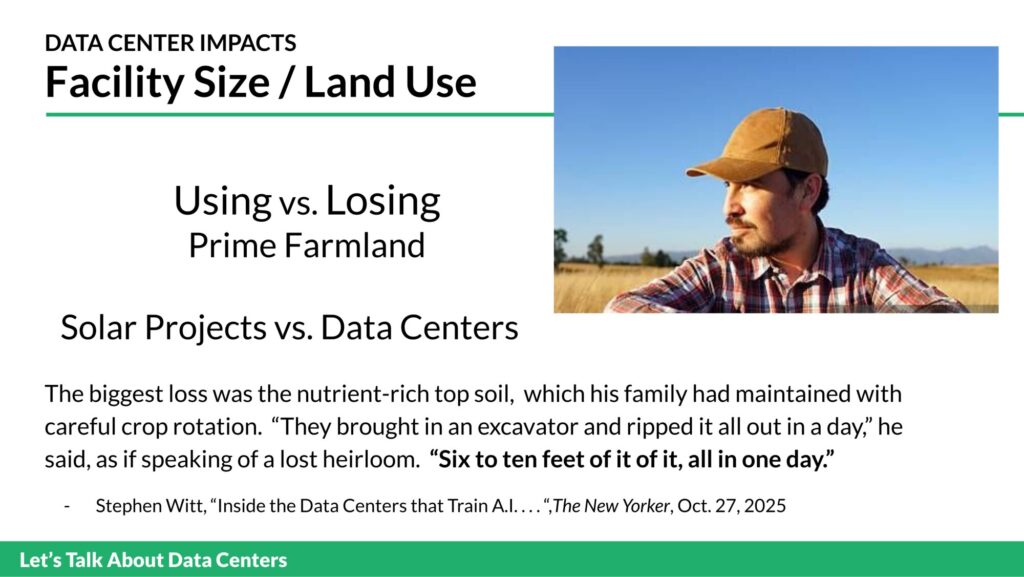
You know, this a lot of this land is typically used for farming, so it’s going to take up prime farmland. And personally, at the Producers Network, we think solar projects are important and valuable and a good use of land. But one distinction. We want to draw is what happens if a solar project goes in on your land versus a data center. Well, a solar project is essentially a twenty-year lease, and that land will come back to you after it’s been leased away. After it’s been a solar farm, and it can go back to farming if that’s the desire of the owner. A data center is going to come in, and that land will never be farmed again. They’re going to take away the topsoil, they’re going to put in a concrete pad, and it’s going to be industrial or light industrial from then on. So this a permanent land use change that data centers are proposing. And like I said, the bigger ones are hundreds of acres. So this is just something to keep in mind in terms of impact on land and how it compares to things like solar.
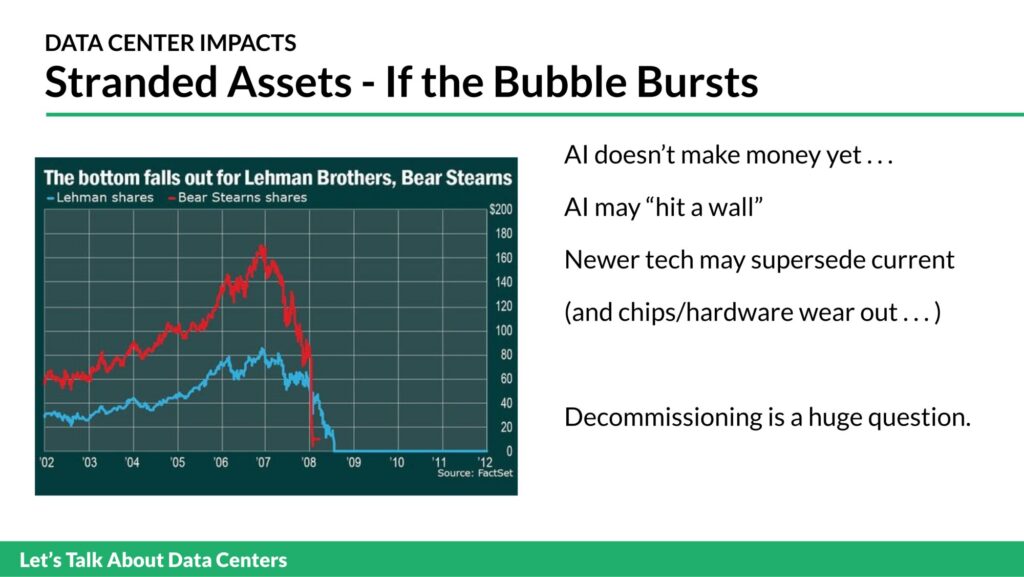
Just to touch on another issue here. Um. Data center, it’s hard to say what’s a bubble or not, and I am not an economist, But I do know that there is a couple of data AI could pan out. AI could become the technology that its advocates are promising. Or it might not. And if it doesn’t, what’s going to happen to all these data centers? Your guess is as good as mine. And I think we need to be thinking about decommissioning because what happens if this facility suddenly gets abandoned by its owner? But I do want to say, even if the AI dream is real, What we’re seeing right now is AI companies in a race. They’re trying to build the compute power that they can build to have the best AI train up the best AI model.
And one of those companies is going to win that race, and when the race is over. What do you do with all those resources? And those resources are our data centers. Where do they go? We no longer need them to win this big race, and everybody has to have their own data centers to win that race, right? So there is sort of another element of this, which is even if AI is real. There might be a bubble element, and so we might be left with a bunch of stranded assets. So, we need to be thinking hard about what is decommissioning. These facilities look like and what assets. Investments are being recouped. And how are we recouping them fast enough that if the data center goes away, we’re not left holding the bag. And if the bubble pops, it could be really bad. I mean, this could be economic impacts way broader than just the data center. But having that data center be gone or useless is certainly not going to help. So we want to think about decommissioning On jobs and property tax, you know jobs are good and.
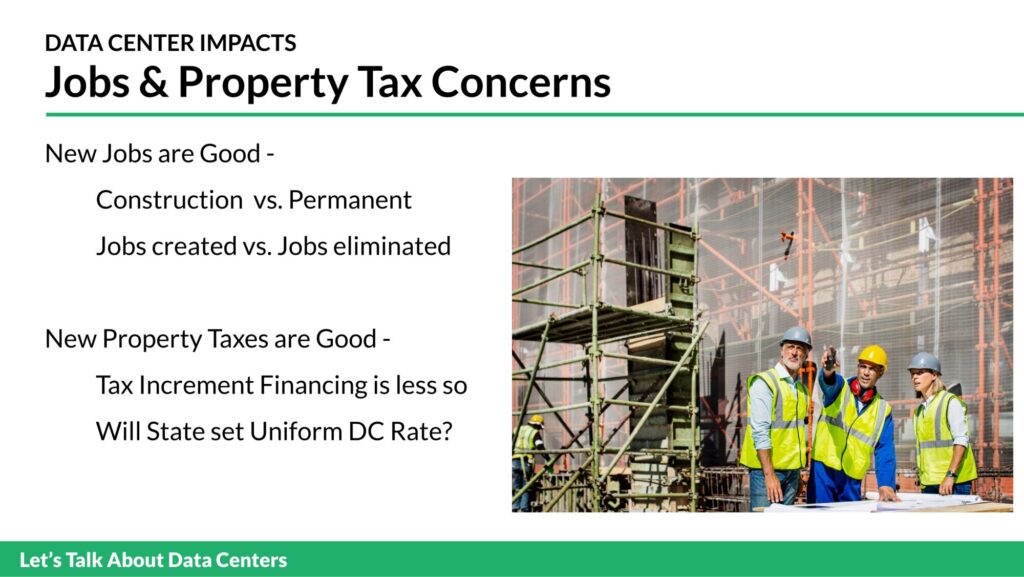
But but we need to be realistic about those jobs. A data center that comes in town is mostly going to be built by. It’s mostly represents construction jobs. And I am an advocate for good union construction jobs, But we just need to be realistic that. That’s a temporary position. And and those benefits may not be flowing back to the communities that are hosting the data center. And then you have long term jobs on site, but those are often not, Actually, that numerous compared to the size of the land use. So I think we just do need to be realistic about that.
Scott Allen
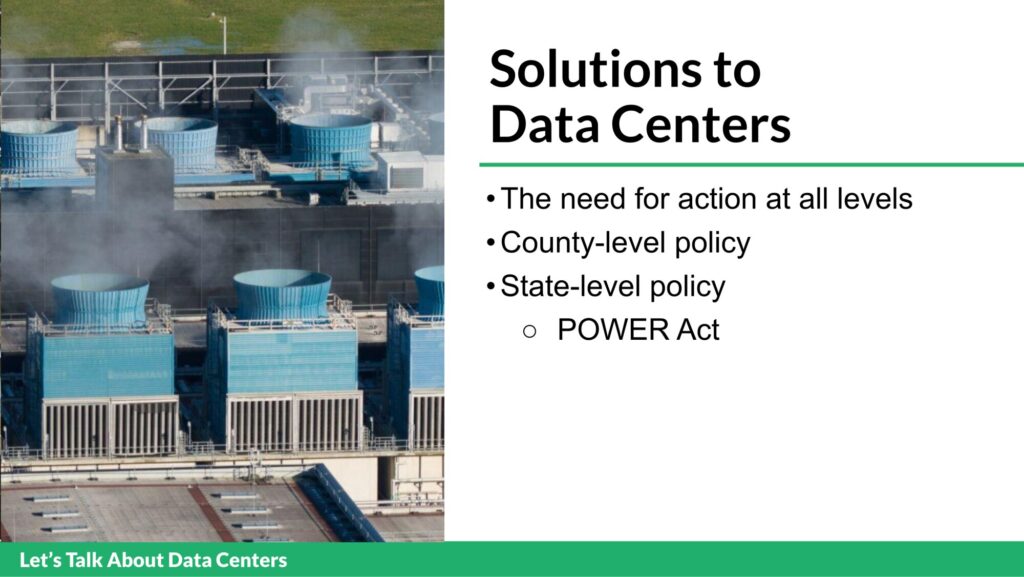
Move on to the solutions part of this. We talked about a whole lot of problems, and we like to come with solutions. As well, I think it’s really important to note that because we’ve seen across the state people really engaged at the local level, which is kind of the first line of defense for this. Showing up for county board meetings, showing up for city council meetings. There are some of the issues, though that we’ve discussed that can only be resolved. The state level or at the local level, for example, all of the kind of land use issues we talked about. That is when the jurisdiction of the county and municipality for the electricity use issues that we talked about. That is something that the state has to deal with, or the federal government has to deal with. There’s nothing much we can do at the local level to mitigate those issues.
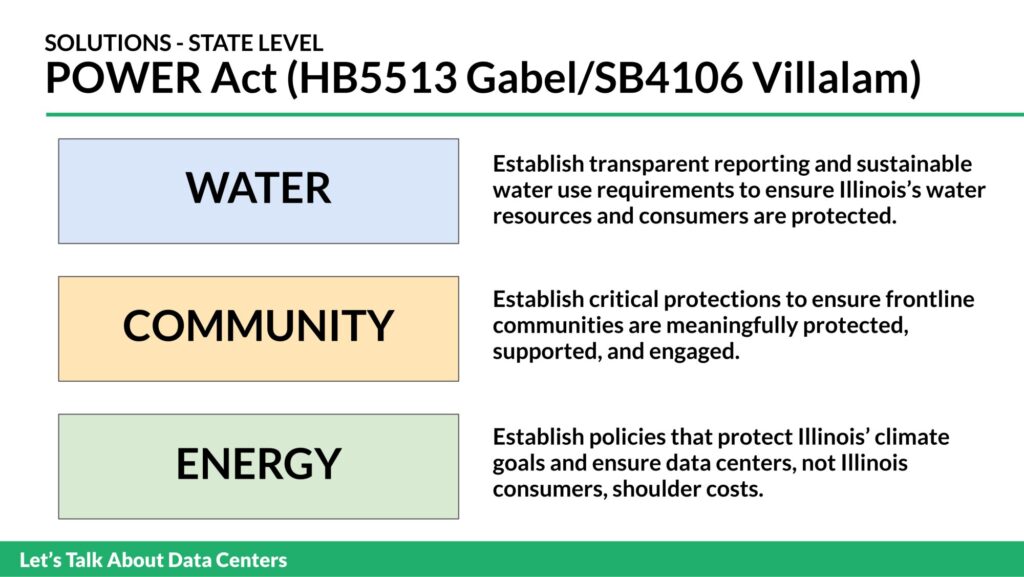
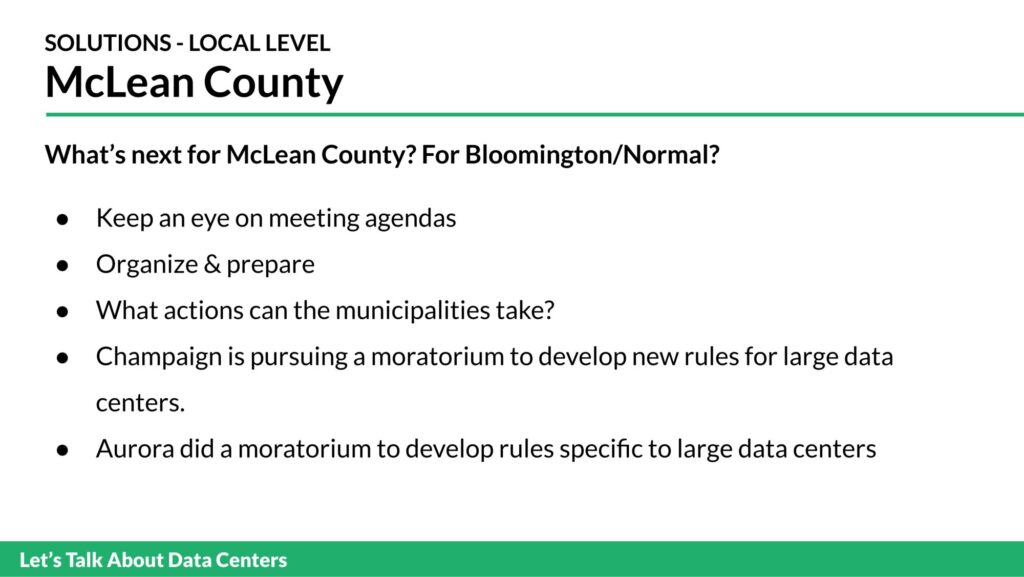
And so, what we’re proposing in the Power Act (the Protect Our Water Energy Ratepayers Act) is setting up the state level because we’re not trying to step on anybody’s toes at the local level. We got to allow those local jurisdictions to set their own rules. And. So we’re going to go through and talk about some of these solutions. But for the local efforts, again, we’ve seen across the state communities coming together. And in some cases, the data center has pulled out. They like forget this; nobody likes us here. We’re gone. We’re going somewhere else. We’ve seen other communities where people do turn out, they do organize, they do show up, and their county board or their municipalities like, “We don’t want to hear any of that. We’re granting the permit because we have to.” So, what we can do as residents of these counties and these municipalities, we have to keep an eye on our county board agendas, our city council agendas. We have to, like, Hopefully, that’s part of what we’re doing here. This evening is people who weren’t in touch with each other who care about this before are now in touch with each other. And I know we have the group, the Facebook group, or being prepared in that way. So somebody’s watching those agendas, and we’re not caught totally off guard when this happens. Um, an example of some of this is like Champaign County. I think Andrew might have mentioned that Champaign County passed a moratorium in the county for a year. We’re about to pass that moratorium for a year this week.
We have a task force to get together because the moratorium is not going to last forever, right? Eventually they’re going to have to start taking applications, But in the meantime, they’re putting together a task force to figure out what do we need to put in our zoning regulations to ensure that we are as protected in this county as possible. At the municipal level, I mentioned that the city of Aurora did the same thing. They put a moratorium in place so that they could take the time. To think about what ordinance, what they wanted to happen in an ordinance. And I would encourage everybody who’s interested in that level of detail to look at the Aurora ordinance because it is very, very well done. They are truly trying to protect their community from what they already know to be causing harm in their community. As for the rest of it, though.
The water of the community and the energy piece of it, I think Andrew is going to come up. And talk about, um, well, you can I’ll let you I’ll let Andrew okay I’ll introduce it. So what we thought about this legislation, when we got together a couple of years ago um and as the clean jobs, coalition started thinking about what kind of regulations do we want to put in place to protect communities. We put it into three broad categories: water uh communities and energy. Um, and I think through land use issues, the water issues, the energy issues we’ve kind of heard about some of the impacts that we’re concerned about there. And now we’ll get into those solutions. And we will start with water.
Andrew Rain
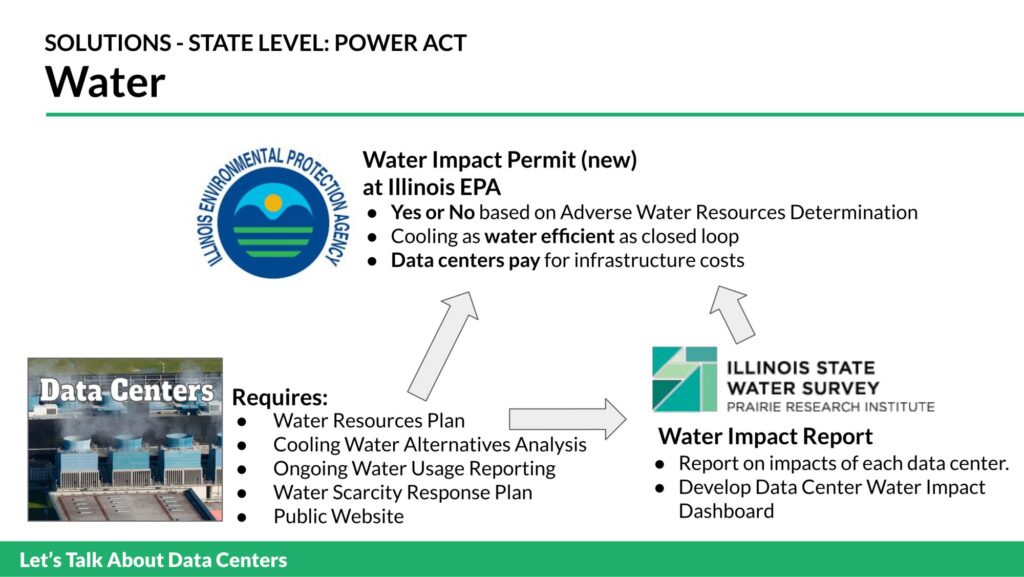
So on water, we are proposing a new water impact permit. This is a yes or no on a data center based on a determination if the data center is likely to cause an adverse water resources impact. Obviously, what does that mean matters a lot. And we did not legislate an exact answer. We created what’s called a rulemaking, which is a deliberative process to come up with some guidance for the Illinois EPA to know what it means if a data center is going to cause an adverse water resources impact. And that rulemaking has guardrails on it, and those guardrails say, you know, we have to be thinking about drinking water. We have to think about ecological uses.
Number of other priorities laid out in that rulemaking. So, We think we’re set up to have a good rulemaking to come up with a good operating definition so that the Illinois EPA can say to a data center, “Look, we looked at your water plan and it’s not going to meet these. We believe it’s going to cause an impact and you’re not, we won’t give you the permit.” So, that’s a yes or no. We’re also in that permit requiring them to do cooling technology for water matters a lot. We’re requiring them to look at an array of cooling technologies and choose one that is at least as water efficient as closed loop, which is one of the better water efficient technologies at the moment. We set a floor, not a ceiling on that because technology is changing very rapidly in the data center space, and we don’t want to say you got to do this. We just wanted to say you got to do something at least as good as this. And if innovation drives them higher, great.
Lastly, we would ensure that data centers are going to pay for the infrastructure costs that they incur. So the pipes to both feed water to the data center and also take water from the data center, they’ve got to be paying for those costs. Similar to what you are going to hear on energy, We want to basically make sure ratepayers are insulated from anything. The data center is causing in terms of cost. So how do we make this permit decision? Well, a lot of transparency goes into it. So the data centers have to make a water resources plan. They have to look at alternatives to cooling. They have to report ongoing water usage, so it’s not just planning. They have to go and say, “Here’s how much we used in every month for both for intake, here’s how much we discharged, here’s how much we evaporated on site.” A water scarcity response plan in case there is a drought, and that they have to at least have a plan on the books that says, here’s how we will respond.
And all this isn’t just being sent to Illinois EPA, it’s going on a publicly available website. So when the county is considering a data center, this stuff goes up there before so all of the community members can say, “Hey look, county board members or city council members, here’s what they’re saying about their water use. “ Um. And obviously, what they say isn’t perfect, but that’s part of the role that our our agencies play. Illinois EPA can assess If they believe that the data center is reporting valid information. The other key piece here is the water resources plan goes to the State Water Survey, and the State Water Survey will do an actual impact analysis. So, the State Water Survey is a research institution at the University of Illinois, and they’re the best prepared to talk about our groundwater, our rivers. They’ve got all that data. So they’ll understand what a natural withdrawal is going to do to those resources, and they’re also reporting that to Illinois EPA. So, we’ve got all this information that will go into a strong water impact permit, and that’s a yes or no.
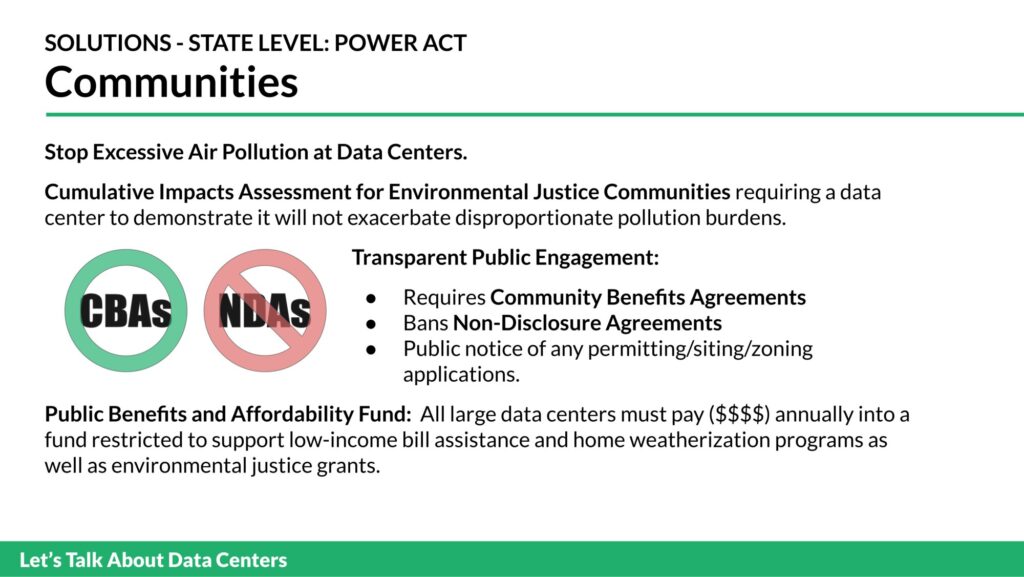
Next community benefits. So the first one is to stop excessive air pollution at data centers, and this is about changing the definition of uh. The emergency backup generators: we’re tightening up what “emergency“ means so that the data centers can’t just claim an emergency and kind of run whenever. It’s not just when prices are too high. So, this is going to really crack down on that excessive use of their backup generation. Really, we’re talking about things like emergencies that involve loss of life. That kind of thing is where they would be allowed to operate their backup generation. So that’s going to help on sound, and it’s going to help on air pollution. We’re requiring a cumulative impact assessment around environmental justice communities. So, these are communities that have been identified and mapped to have sort of excessive pollution burdens. And the Illinois EPA will be responsible for demonstration of this data center is not going to cause too much pollution in these communities in the context of all the other pollution around. So this is called the cumulative impact assessment, and it’s really sort of a…. We aren’t doing that in other places, so this is kind of a state-of-the-art sort of regulatory scheme for ensuring that burdens are not too high on EJ (Environmental Justice) communities. Next, on public transparency, we like community benefits agreements so much that we’re going to require one. And we ban nondisclosure agreements because we think transparency is important. And, any sort of permitting or siting or zoning applications have to be posted online. And lastly, all large data centers so large in this case means fifty megawatts or bigger, which as I noted before, is like a huge range of data centers at this point. But, all the large ones have to pay money that scales with how big they are annually into a fund. And that fund is uh used to support things like low income, bill assistance or home weatherization programs as well as things like the environmental justice grants program that was created by a law a few years ago.
So we’re creating a funding source for benefits that will flow back into communities. In addition to the community benefits agreement that will, you know, is directly negotiated between a group that comes together to represent the community and the data center, and that’s all public. So those we’ve seen CBAs (Community Benefit Agreements) that happen behind closed doors, and those aren’t going to be allowed either. So that’s water in communities, and I think I’m back to Scott on energy.
Scott Allen
Okay, so. This, luckily, is a little easier to understand. It’s a little more straightforward than the trial part of it. So, remember, when I said that the data center says that they’re going to pay for all this infrastructure up front? And I say, well, that can’t happen because that’s not how our rules are set up. What we’re proposing is that our investor utilities again will get to the corn belts in a second, but for Ameren and for Com-Ed, they need to write a tariff.
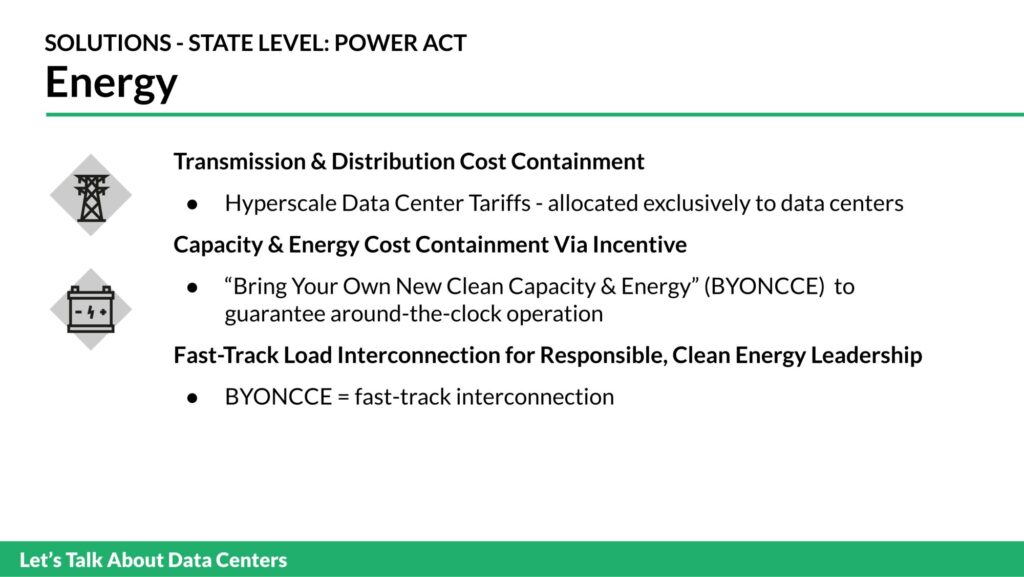
There are the rules of the road for interconnection for every customer class, so for residential customers, commercial. And in that tariff, the utility describes all the terms of service to be interconnected to them and all of the cost allocation. So who pays for what, when and how? What we’re proposing is that the utilities create a tariff class only for data centers. So, when the data center builds that the utility builds that infrastructure for the data center. If the data center decides that never mind, we only need half of that, or that bubble pops right in the middle of the utility purchasing all that infrastructure and building it, those costs cannot leak out of that rate class and into us, residential or the commercial rate payers. It’s a bit Riskier, I think, for the utilities because utility is a zero-risk business. They’re guaranteed a profit by regulation. And the way they do that is if something goes wrong, they just take it from the ratepayers. Well, we want to ensure that those ratepayers. In this class are other data centers. And so, if something goes wrong with somebody in that class, they can only take it from those other data centers. On the energy side of that, we talked about these capacity auctions and potential energy scarcity and generation scarcity. Our solution is fairly straightforward. Again, that you bring your own new clean energy and capacity. There’s a practical reason for powering data centers with renewable energy as well, and that’s that under the best circumstances, to build a gas plant, you are looking at about seven years. A nuclear plant, the last one that was just built and recently opened in the United States down south, took about thirty years to build and something like nearly forty billion dollars. The only resources that we can build out quickly enough to match data center load is renewable energy and storage. It’s the only thing that is available to us that is not a backlog. That does require a lot more planning, but we don’t need to get into that here. And in order to entice a data center to do this, to be the better actor here, we’re saying because we figure a data center cares about two things: one, like Andrew said, they’re trying to be the first to the market to open their data center to win that first leg in the race.
So that’s one thing. They also, especially for training AI, they want to run around the clock. So we’re saying that if you bring your own clean energy and capacity, you can cut to the front of the line for interconnection. So you get a leg up on your competition, and we will insure you if you bring eighty percent of your own energy and capacity. We will ensure that eighty percent of your load is served. Otherwise, we’re going to curtail you if you need curtailing. So, if you bring nothing, you wait in the back of the line. And if we have a situation where rolling blackouts occur, your data center is probably going to be part of that rolling blackout. So, the only way that you can do that is if you bring enough to serve your own energy. It has to be new, it has to be clean, and as of now, nuclear does not fit that definition.
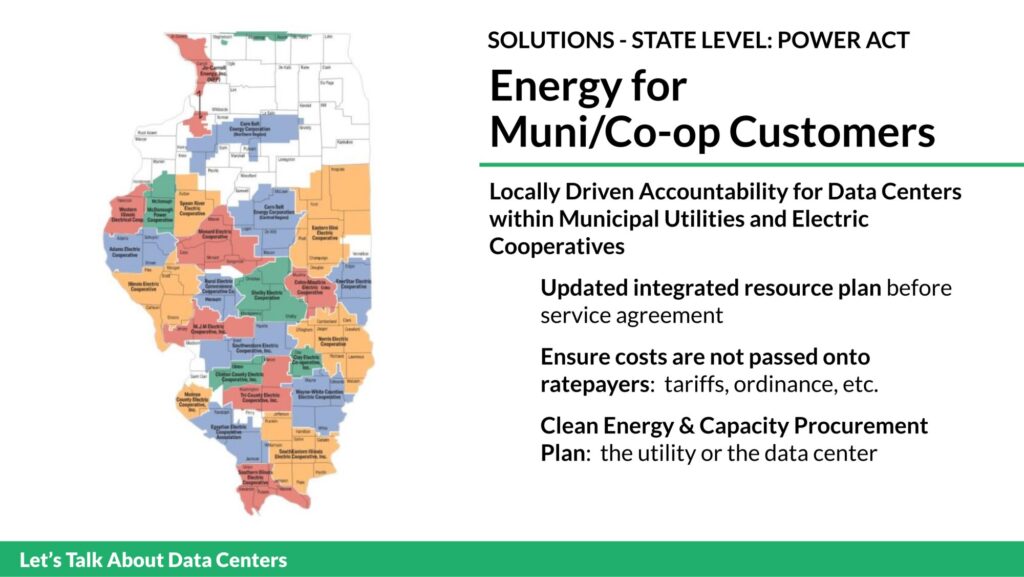
For the Cornbelt people, and all of the rest isn’t a map you can see of all the generation and transmission utility co-ops, utilities in the state. We have a lot of co-ops and a lot of municipal utilities in the state of Illinois. A lot of them. They have no state regulation. So these, just like all the problems that I talked about with the investor owned utilities, those problems still do exist in different forms for the publicly owned utilities and the co-operative lego utilities. The difference is, is that they are not regulated by the Public Utilities Act. And the way that we’re going to pass, hopefully, all of this legislation that I just mentioned is through the Public Utilities Act. So our municipal utilities and our co-op utilities are rate payers, are sort of left exposed.
So what we’re what we’re proposing is last year, we managed to pass a law that said that these publicly owned utilities have to do resource planning. That’s never been a requirement, hard as it is to believe in this state. Now, they are required to at least do some resource planning and show their members and owners. Here’s how we intend to meet load. If they’re going to hook up a data center, they first have to show. They have to redo their resource plan to show how they’re going to meet that need. Then, we also want to ensure that they are not passing costs on to their other rate classes. So, we’re saying that we also want you to make a tariff to keep these costs contained into those data centers. And we want to put the same energy and capacity requirements on them. And if you are going to locate a data center here, you can’t just shove that problem off onto the grid.
You have to make sure that they are building and bringing their own energy within five years. Otherwise, the rest of us have to deal like, you know, a co-op is not a grid unto itself. It doesn’t exist on its own. It is connected to the rest of this grid too. It plays in the same markets, it works a little bit differently, but it’s all connected together. There are a million or so rate payers for municipal and co-op utilities in the state. We can’t have those people exposed. We can’t make one set of rules for one set of utilities and just leave everybody else exposed.
Andrew Rain
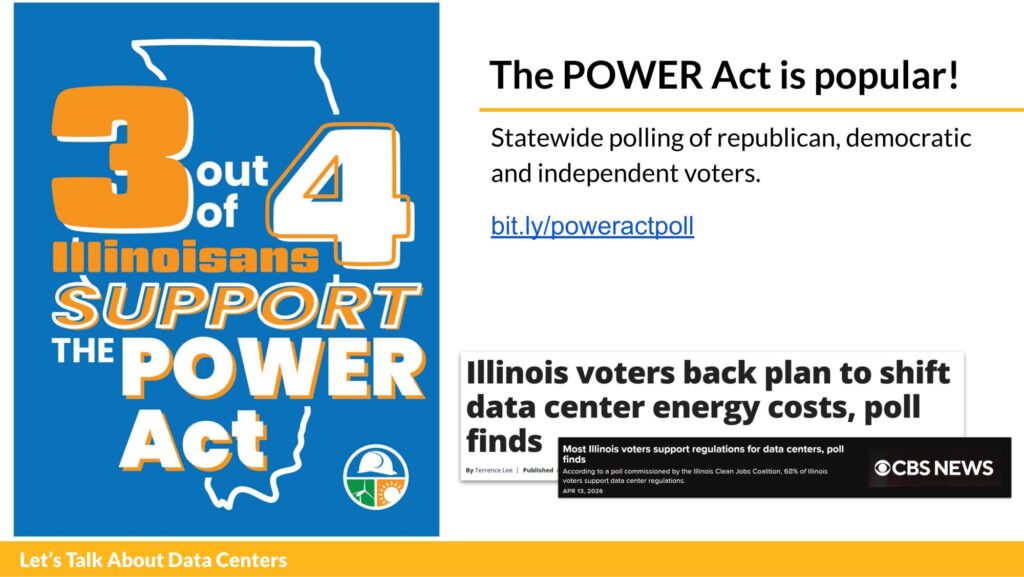
All right, folks, We’ve just got a couple more slides and then we’re all done for the night. And thank you a lot for coming out. We did polling on the Power Act. We hired a firm to do polling across the state, Democrats, Republicans, Independents, everybody. And we found that three out of four Illinoisans support the Power Act. So, there is wide support to regulate data centers in Illinois. So that’s the good news if you feel like data centers should be regulated. And if you want to take a look, you can see some of the information in that poll. If you go to the bit.ly/poweractpoll. That doesn’t necessarily always mean that just because it’s popular, that Springfield’s going to do something about it, right? So it’s important for people to keep raising their voices.
You can even put this poll in front of legislators because I think that will motivate them. They like data, and they like to see polling numbers. It is three out of four, it’s bipartisan. This is a bipartisan issue. Everybody cares about their water, everybody cares about their electric bills. It’s an important thing, and I think we can get a lot of people behind it if they just hear this message. So with that, Sonny’s going to tell you about some of the ways that you can take action on data centers.
Sonny Garcia
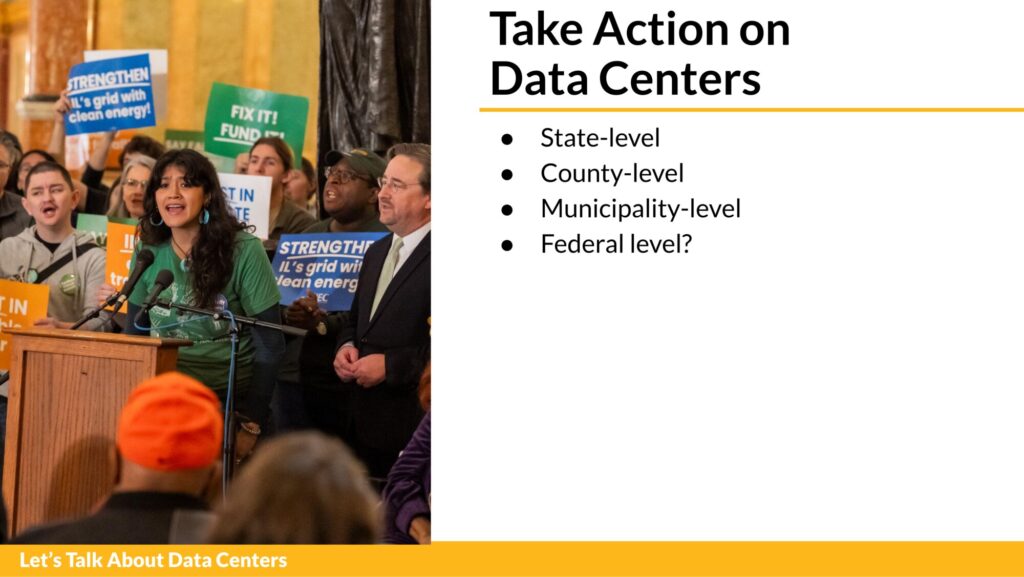
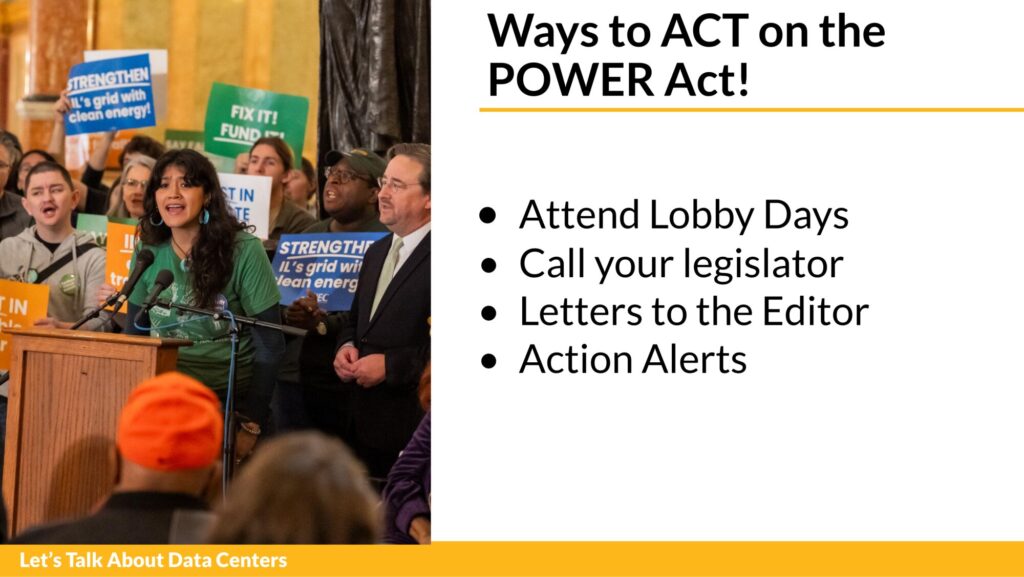
Okay, So here are some of the things that we can do as far as action steps. Like we were talking about earlier, you could act on the local, county, state and federal level. What we’re talking about with the Power Act that’s definitely on the state level. So you can attend lobby days, call your legislator. Letters to the editor and sign up for action alerts. We actually got a handout at the table you guys are walking out. Please grab one of those. To get updated on the action alerts.
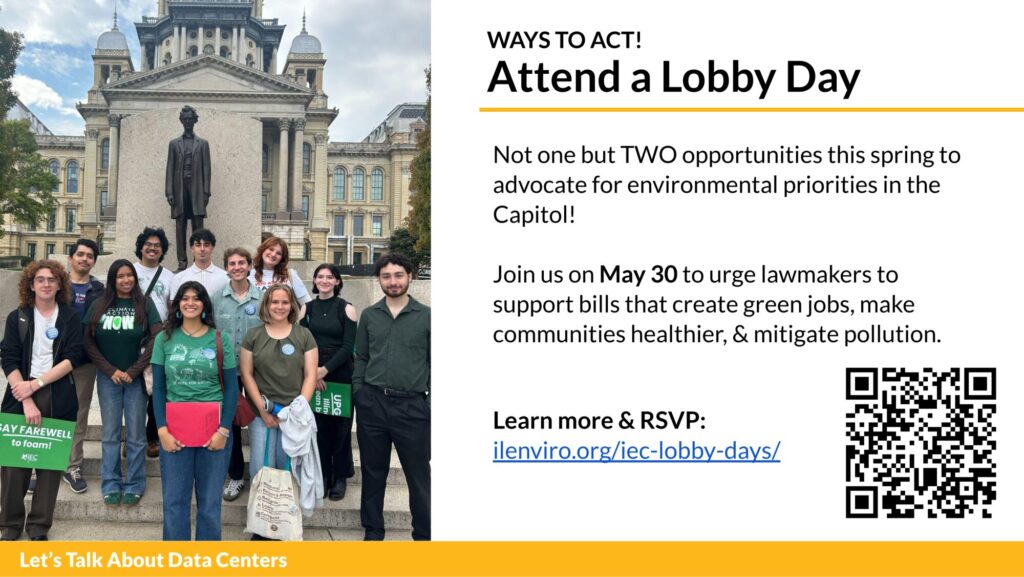
But, one of the first steps of action that we’re taking this year is we’re attending lobby days. Our next lobby day is going to be on May 30th, which is a Saturday. We did one April 8th, a couple of weeks ago down in Springfield, had some good turnout. Um, but we’re we’re trying to turn out a thousand people for this this May 30th event. Um, you can sign up at that action sheet that I gave you, or you can scan this QR code and reserve your spot on the bus. The way that works, if we get enough people from Bloomington to sign up, probably like thirty to fifty people, we’ll get a bus in Bloomington. You guys don’t have to drive. So make sure tell your friends if you know that you’re free that day — which is it is a Saturday, so most people don’t have to work — you can come down Springfield and join advocates from all across the state. It’s going to be a real, real fun time, and we’ll give you lunch and talk to your legislators.
So that leads us to this. This sends a letter directly to your legislator, letting them know that you support the Power Act, And hopefully, you know, that will pressure them a little bit to get this passed this year.
And of course, letters to the editor. Lisa will help you with that. Her email is right there if you need assistance in putting that together. She’s great, so please do that. The more people we got talking about this, the better. I also want to add that we have a lot of people in this room: over eighty people, But I know that there is a lot of people in this community who care about this issue. So if you guys, your church, your community organization wants to do a similar meeting with your group doesn’t matter if it’s five people, doesn’t matter if it’s a hundred people. Definitely reach out to us and and we’ll be there to uh help uh support you.
Andrew Rain
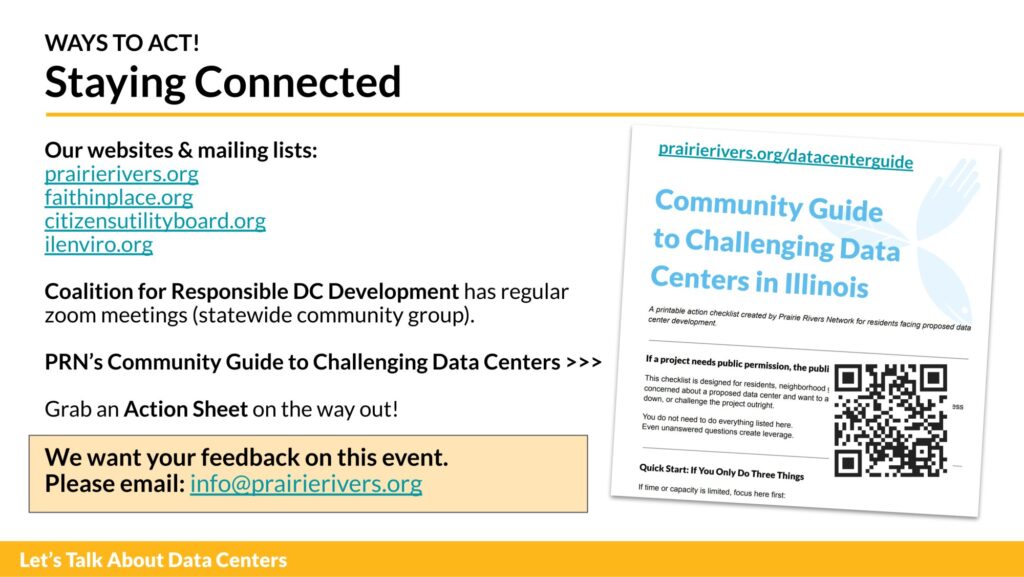
That’s it. It’s our last slide. There’s a couple ways to stay connected. Our email or our websites are all listed there. We all have listserv that you could join to learn more about what our organizations are working on. I do want to mention, there is the Coalition for Responsible DC Data Center Development. That’s our group of folks who are, connecting communities across the state for community members who are dealing with the data center, connecting them to other community members who are dealing with the data center to help share resources, support each other. So it’s kind of a if you were interested in joining that group, please come to me after the meeting. I can help connect you. We’ve got a guide that is useful for steps for how you can challenge a data center that might show up in your community. You can scan the QR code. The guide is also on the action guide, all the QR codes are on the action guide on the table, so just grab one on the way out. And yeah, I’d love your feedback on the event. You can write your feedback on the sheets, or you can email us at info at prairierivers.org to hear about what you thought about the event. I think that’s it. Thank you so much.